













Book Review: The Approved Mental Health Professional Practice Handbook
- Details
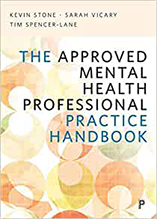 This handbook provides in-depth guidance on all key aspects of being an Approved Mental Health Professional and considers the ethical challenges involved in the role. Alex Ruck Keene gives his thoughts on the text.
This book fulfils a very important role for those who are training to become Approved Mental Health Professionals, those acting as AMHPs, and – I suggest – those working alongside AMHPs. It does not seek to be a one-stop-shop for the legal provisions that are so central to the discharge by AMHPs of their role (nor to replace the acknowledged Bible of the law in this area, Richard Jones’ Mental Health Act Manual[1]). Nor does it seek to direct AMHPs in the way that the Codes(s) of Practice to the Mental Health Act.[2] Rather, it seeks to put the role of the AMHP into its wider context, and to enable putative and practising AMHPs to reflect upon their complex – and crucial – role. It does so in clear, accessible text, divided into three parts: (1) the AMHP in context; (2) the AMHP in practice; and (3) the AMHP in theory.
A key message of the book is the evolution both of mental health (and connected) legislation and its application in practice – and the authors even manage to address the (so far unimplemented amendments to the MHA 1983 contained in the Coronavirus Act 2020, as well as flagging areas where further change is likely, to be addressed in online resources (the page at present awaiting updates).
The authors are to be congratulated on a work which contains a huge amount within a (relatively) short compass, and will be sure rapidly and rightly to be bought and thumbed extensively by those working in this complex but vital role.
[1] Although not referred to in the handbook, a rather easier read for those who want to navigate their way through the provisions of the MHA is the opening part of the Mental Health Tribunal Handbook (LAG 2015), which contains an excellent and accessible outline of the Act.
[2] One of the book’s strengths is the way that it addresses the numerous differences between the way that the MHA is implemented in practice in England and Wales, not least through the operation of separate statutory Codes for both.
[Full disclosure: I was sent a review copy by the authors. I am always happy to review works in or related to the field of mental capacity, health and mental law (broadly defined)]
Alex Ruck Keene is a barrister at 39 Essex Chambers. This review first appeared on his Mental Capacity Law and Policy blog.
Jobs








































Principal Lawyer

Lawyer - Contract, Procurement and Information Law

Senior Planning Lawyer

Litigation Lawyer

Chief Lawyer - Contracts

Solicitor
Locum roles
Directory














Events













































 PATC | Update on care proceedings - Hugh James
  4-5 Housing Conference 2026 - 4-5 Grays Inn Square
  Building Safety Conference - Westminster Insight
  How to Handle a Subject Access Request - Act Now
  Managing the Commercial Market Operator (CMO) principle in Subsidy Control - DWF
22-09-2026 11:00 am
Online (live)
 Certified Information Privacy Manager (CIPM) - The Training Centre
  Management Agreements - Devonshires
  AI and Data Protection in Employment - Pitfalls and How to Avoid Them - Sharpe Pritchard
23-09-2026 9:30 am
Online (live)
 Property & Real Estate Conference 2026 - New Square Chambers
  Cornerstone on Social Housing Fraud: book launch and panel discussion - Cornerstone Barristers
23-09-2026 4:30 pm
London
 Information & Records Management Practitioner Certificate - Act Now
  Public Sector Insights Cymru: Health Impact Assessment (Wales) Regulations 2025 - Blake Morgan
24-09-2026
Wales
Frameworks and dynamic markets under the Procurement Act 2023 - DWF
24-09-2026 11:00 am
Online (live)
 Webinar: Human Rights assessment (Nationality, Immigration and Asylum Act 2002) - Spire Barristers
24-09-2026 4:00 pm
Online (live)
 Planning Enforcement and Advertisements - Ivy Legal
  Minerals webinar series - Part 4: Local Authority / MHCLG / DEFRA - Landmark Chambers
28-09-2026
Online (live)
 No such thing as bad PR? - Exploring Parental Responsibility - 42BR
The new legislation expanding the duty to prevent harassment in the workplace - DWF
No such thing as bad PR? - Exploring Parental Responsibility - 42BR
The new legislation expanding the duty to prevent harassment in the workplace - DWF
29-09-2026 12:00 pm
Online (live)
 Property Law Roadshow - Cornwall 2026 - St John's Chambers
  Annual Planning Forum 2026 - Francis Taylor Building
  PATC: Equal pay in local government - Hugh James