













Book Review: Button on Taxis
- Details
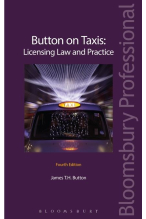 After an eight-year gap there is a new edition of Button on Taxis. Professor Roy Light reviews the publication and the changes made.
Button on Taxis: Licensing Law and Practice 2017. Bloomsbury Professional, Haywards Heath. £115 hard cover.
Originally titled Taxis – Licensing Law and Practice the first edition appeared in 1999, the second in 2004 and the third in 2009. On checking the date of the first edition on Amazon I was somewhat taken aback to see that the two third editions offered for sale were each priced at £1,639 (plus £2.80 postage). Thus confirming the widely held view that this book is indeed worth its weight in gold.
Eight years has seemed a long wait for the fourth edition, but it is a testament to the book’s enduring value that the last edition despite its age continued to be the first port of call for those wanting guidance on taxi licensing.
As the author states: "the changes have been many and varied since the last edition" and understandably with prospective developments pending he decided to delay publication to allow coverage of these. Even so, the short time between completion of the volume (October 2017) and today has seen some significant developments; in particular, ‘cloud’ based booking systems which finally were addressed in Milton Keynes Council v (1) Skyline Taxis and Private Hire Limited (2) Gavin Sokhi [2017] EWHC 2794 (Admin). The issues involved in the case are well flagged in chapter 12.
The latest edition continues to offer the comprehensive coverage and clear exposition so welcomed in previous volumes. Much has happened in the taxi world during those eight years and the book deals with these matters admirably. It has not just been a matter of fitting updates into the text but where necessary a comprehensive rewrite of sections has been undertaken which present the law in a fresh and accessible style. Many books continue to include material that is no longer of any other than historical interest and while this may be welcome in some volumes, those grappling with the application of law and procedure need a route map through rather than an historical exposition. Button is an excellent example of the practical and pragmatic approach. Even so the text of the fourth edition runs to some 200 pages more than the third.
The layout of the book follows that of the previous edition which is comforting for those used to navigating that volume. And, as with previous editions, there are appendices containing legislation, circulars and guidance.
The chapter on fees has almost doubled in length and no doubt will be welcomed as a useful introduction for those involved in the numerous fee challenges being mounted around the country in the wake of Hemming. (The latest edition of the LGA publication Open for Business: LGA guidance on locally set licensing fees June 2017 is also very helpful.) The chapter on enforcement sees a significant increase in size adding coverage of penalty points schemes and licence suspension post Singh; while the Equality Act and Immigration Act are integrated into the text at appropriate places.
This book is indispensable for all those involved in taxi licensing and is highly recommended.
Professor Roy Light is a barrister at St John's Chambers, Bristol
Jobs







































Litigation Lawyer

Solicitor

Chief Lawyer - Contracts

Senior Planning Lawyer

Principal Lawyer

Lawyer - Contract, Procurement and Information Law
Locum roles
Directory














Events











































 PATC | Update on care proceedings - Hugh James
  4-5 Housing Conference 2026 - 4-5 Grays Inn Square
  Building Safety Conference - Westminster Insight
  How to Handle a Subject Access Request - Act Now
  Managing the Commercial Market Operator (CMO) principle in Subsidy Control - DWF
22-09-2026 11:00 am
Online (live)
 Certified Information Privacy Manager (CIPM) - The Training Centre
  Management Agreements - Devonshires
  AI and Data Protection in Employment - Pitfalls and How to Avoid Them - Sharpe Pritchard
23-09-2026 9:30 am
Online (live)
 Property & Real Estate Conference 2026 - New Square Chambers
  Cornerstone on Social Housing Fraud: book launch and panel discussion - Cornerstone Barristers
23-09-2026 4:30 pm
London
 Information & Records Management Practitioner Certificate - Act Now
  Public Sector Insights Cymru: Health Impact Assessment (Wales) Regulations 2025 - Blake Morgan
24-09-2026
Wales
Frameworks and dynamic markets under the Procurement Act 2023 - DWF
24-09-2026 11:00 am
Online (live)
 Webinar: Human Rights assessment (Nationality, Immigration and Asylum Act 2002) - Spire Barristers
24-09-2026 4:00 pm
Online (live)
 Planning Enforcement and Advertisements - Ivy Legal
  Minerals webinar series - Part 4: Local Authority / MHCLG / DEFRA - Landmark Chambers
28-09-2026
Online (live)
 No such thing as bad PR? - Exploring Parental Responsibility - 42BR
The new legislation expanding the duty to prevent harassment in the workplace - DWF
No such thing as bad PR? - Exploring Parental Responsibility - 42BR
The new legislation expanding the duty to prevent harassment in the workplace - DWF
29-09-2026 12:00 pm
Online (live)
 Property Law Roadshow - Cornwall 2026 - St John's Chambers
  Annual Planning Forum 2026 - Francis Taylor Building
  PATC: Equal pay in local government - Hugh James