The role of the backbench councillor
- Details
Backbench councillors in local authorities with a Leader/Cabinet model are often regarded as having little or no power to influence or take part in decision-making. In a two-part series, Geoff Wild examines how they can flex their muscles, starting with the Councillor Call for Action.
The Councillor Call for Action (CCfA) was introduced by the section 119 of the Local Government and Public Involvement in Health Act 2007 (through section 21A(1)(c) of the Local Government Act 2000) and the Overview and Scrutiny (Reference by Councillors) (Excluded Matters) (England) Order 2008. It applies to all councils (except parish councils) and enables any member of the council to bring matters of community concern within their ward or division to the attention of the council via the scrutiny process where other methods of resolution have been exhausted without success. It is intended to enhance the council’s scrutiny arrangements and provide a formal mechanism to enable elected members seek positive outcomes for the citizens they represent, provided all other means of resolution have been exhausted.
The Police and Justice Act 2006 and the Crime and Disorder (Overview and Scrutiny) Regulations 2009 also make provision for a Call for Action regarding crime and disorder issues in a member’s ward to a committee specifically appointed by the authority to deal with crime and disorder matters.

CCfA goes beyond the previous power overview and scrutiny Members had to raise issues. It gives all members the ability to call for debate and discussion at an overview or scrutiny committee on a topic of neighbourhood concern. Previously, under s.21 of the Local Government Act 2000, only members of an overview or scrutiny committee had the right to ensure that any matter which was relevant to the functions of the committee was included on the agenda and discussed.
CCfA is therefore a process that puts local councillors at the forefront of dealing with issues of concern in their local communities. It gives them a central role in calling to account the work of council services and other agencies at a local level. When concerns are identified (either as a result of information from individuals, community groups or a councillor’s own observations), they should be able to trigger a response from service providers and help ensure those concerns are dealt with. As a last resort, when a problem cannot be solved, the CCfA can trigger a local scrutiny review.
The CCfA is intended to provide greater emphasis to the vital work undertaken by councillors as community advocates and champions, and to further increase the accountability of public service providers to local communities.
Option of Last Resort

However, the CCfA should be considered as an option of last resort. A CCfA should only be included on a scrutiny committee agenda if:
(a) The member has made all reasonable efforts to resolve the matter via liaison with council officers and/or relevant partner agencies;
(b) The issue of concern relates to the discharge of a council function (including where this is undertaken with partners and other service providers);
(c) The issue of concern has a demonstrable impact on all or part of the member’s ward or division; and
(d) The call for action does not relate to:
-
- individual complaints concerning personal grievances or commercial issues, for which the council’s complaints procedure should be followed
- matters that have a statutory appeals process, e.g. planning and licensing applications, council tax queries, housing benefits complaints, issues under dispute in a court of law, etc.
- matters where there is a statutory right of review or appeal (not including the right to complain to the Ombudsman), e.g. a matter relating to a housing benefit appeal
- matters that are vexatious, discriminatory or unreasonable
- matters of wider council policy, i.e. if an issue affects more than one ward or division it may be appropriate to refer it to the Scrutiny Committee for consideration of its wider strategic or policy implications, rather than focusing on one particular ward or division
- questioning Cabinet decisions that have been taken but not yet implemented, for which the call-in procedure should be used
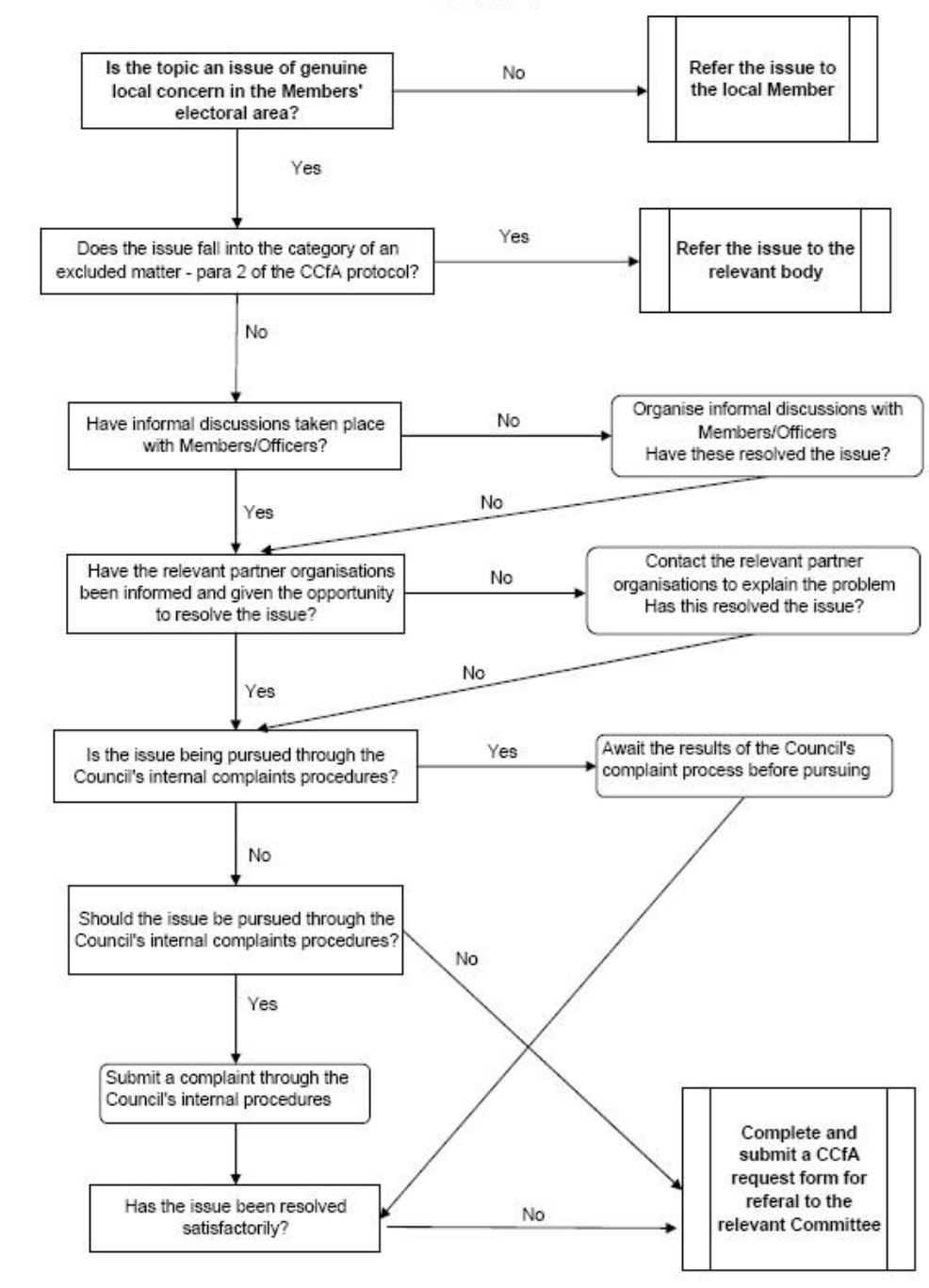
The flowchart at Appendix A may assist in deciding whether an issue is ready for referral to a scrutiny committee as a CCfA.
Outcomes available
Having considered a CCfA, a Scrutiny Committee may take one or more of the following actions:
(a) Ask for further information to be brought to a future meeting
(b) Require the attendance of Cabinet members or senior officers to attend a future meeting to answer questions
(c) Set up a task and finish group to undertake an in-depth review
(d) Make a report or recommendations to the Council, Cabinet or partner agency and:
-
- publish that report
- request the Council or Cabinet to consider and respond to the report, setting out what action it proposes to take and to publish its response
- request a partner agency to have regard to the report when exercising its functions
If a Scrutiny Committee decides to take any action then it will inform the member who raised the CCfA and provide them with a copy of any report or recommendations made in relation to the CCfA, together with any response received from the Cabinet or a partner agency.
If the Scrutiny Committee decides not to consider a CCfA or on consideration decides no further action is necessary, it should inform the member who raised the CCfA and explain the reasons why.
Geoff Wild is a Legal and Governance Consultant. He is celebrating his 40th anniversary as a local government lawyer.
In the second article, Geoff will look at the little-used power for councils to delegate executive and non-executive functions to individual Ward members.
CLICK ON IMAGE TO ENLARGE
This is the latest in a series of articles Geoff has written – previous contributions
- What is an Officer?
- Councillors in an increasingly digital age
- Dual-hatted members and local government reorganisation
- Member and officer indemnities
- Complying with the Public Sector Equality Duty
- Members’ interests, bias and pre-determination
- Who runs councils in no overall control?
- Recording and publishing officer decisions
- The role of substitutes
- What next for parish councils?